
175
แชร์
Many may think that the transformation to digital technology for an organization requires new tools and equipment or the purchase of innovations for use in the workplace. In reality, it is continuously learning to develop everyone in the organization’s skills that will drive the organization to its goal.
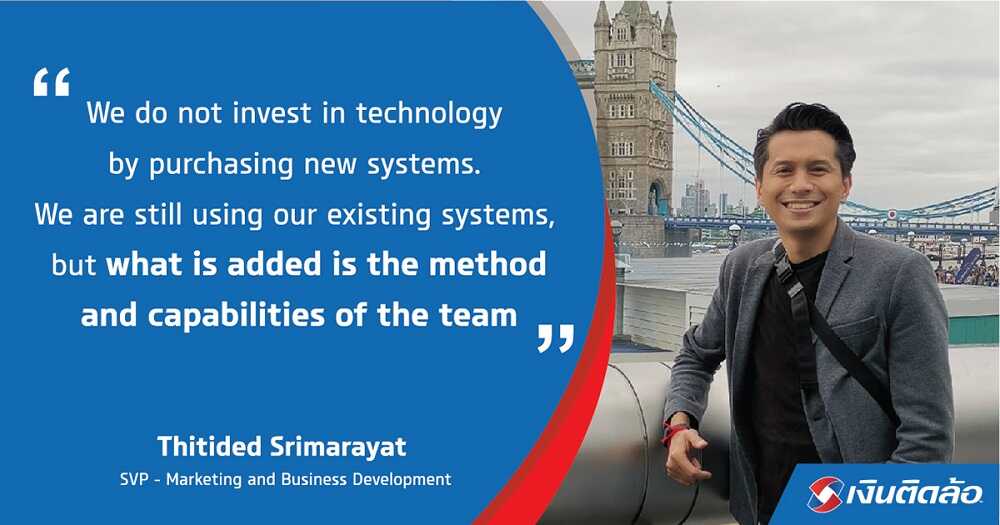
“We do not invest in technology by purchasing new systems. We are still using our existing systems, but what is added is the methods and capabilities of the team.”
This is what Ded - Thitided Srimarayat, SVP - Marketing and Business Development, told us about how the company operates amidst the rapid technological change. In his view, the key that will drive an organization toward its goal is the “people.”
“Our work today is divided into two parts that are executed simultaneously. One is BAU or Business As Usual, which is the normal execution of functional operations that focus on the present. The other is what we call BTF, or Build the Future. In the future, when we go full digital, digital technology will be integrated into all areas of business to speed up the work process. Therefore, we will need to reskill BAU staff to broaden their digital perspectives.”
Because the existing skills can be replaced with technology, reskilling is to add new skills to enable a team to work consistently with innovation and BTF trends. Currently, Ngern Tid Lor is planning to develop robots to help perform certain repetitive operations, while reskilling staff who used to work in these areas so that they can perform BTF to create value for the employees and the organization.
The skills added must go hand in hand with the changing work. In the past, software development followed the waterfall model, which is a sequential software development process, where progress flows from designing, evaluating, developing, testing and market launch. From the start to finish, some projects may take about half a year and what is being developed may be outdated by the time it is completed. If we still follow the same old model, we may be left behind in the era where digital technology dominates the world.
“Our A&D (Analytics and Development) and IT teams have worked together to propose frameworks known as Agile and Scrum that focus on smaller teams developing and testing new innovations faster. Our IT team has applied these frameworks for almost two years to develop software. Every two weeks, we can see and use new innovations and develop new functions using different work methods, allowing us to create new items quickly while developing the skills and abilities of staff.”
At Ngern Tid Lor, we place importance on continuous learning and experiments to lead change, which is one of our seven core values. Both our new and long-time employees are eager to learn and engage in self-development through trial and error, by going on a trip to broaden their horizons, and listening to others. Thus, when we began the transition to digital, reskilling was not difficult at all. Instead, it helps everyone to be onboard with our goal faster.
“We do not invest in technology by purchasing new systems. We are still using our existing systems, but what is added is the methods and capabilities of the team.”
This is what Ded - Thitided Srimarayat, SVP - Marketing and Business Development, told us about how the company operates amidst the rapid technological change. In his view, the key that will drive an organization toward its goal is the “people.”
BAU vs. BTF
“Our work today is divided into two parts that are executed simultaneously. One is BAU or Business As Usual, which is the normal execution of functional operations that focus on the present. The other is what we call BTF, or Build the Future. In the future, when we go full digital, digital technology will be integrated into all areas of business to speed up the work process. Therefore, we will need to reskill BAU staff to broaden their digital perspectives.”
Because the existing skills can be replaced with technology, reskilling is to add new skills to enable a team to work consistently with innovation and BTF trends. Currently, Ngern Tid Lor is planning to develop robots to help perform certain repetitive operations, while reskilling staff who used to work in these areas so that they can perform BTF to create value for the employees and the organization.
When the method changes, the outcome will also change
The skills added must go hand in hand with the changing work. In the past, software development followed the waterfall model, which is a sequential software development process, where progress flows from designing, evaluating, developing, testing and market launch. From the start to finish, some projects may take about half a year and what is being developed may be outdated by the time it is completed. If we still follow the same old model, we may be left behind in the era where digital technology dominates the world.
“Our A&D (Analytics and Development) and IT teams have worked together to propose frameworks known as Agile and Scrum that focus on smaller teams developing and testing new innovations faster. Our IT team has applied these frameworks for almost two years to develop software. Every two weeks, we can see and use new innovations and develop new functions using different work methods, allowing us to create new items quickly while developing the skills and abilities of staff.”
Open corporate culture makes faster progress
At Ngern Tid Lor, we place importance on continuous learning and experiments to lead change, which is one of our seven core values. Both our new and long-time employees are eager to learn and engage in self-development through trial and error, by going on a trip to broaden their horizons, and listening to others. Thus, when we began the transition to digital, reskilling was not difficult at all. Instead, it helps everyone to be onboard with our goal faster.
“Because we have a strong corporate culture, opening to new things and ideas is not difficult for our employees. When the organization makes a full digital transformation, everyone must be onboard with the understanding that digital technology can help make work easier and they can switch to BTF. Eventually, when BTF becomes BAU, we have to reskill again to achieve better development.”
