

Each organization has different goals, work methods, and nature of people in the organization. Designing corporate culture following trends while overlooking shared goals of company and employees is therefore considered a misstep. For example, Ngern Tid Lor PLC once planned to instill corporate culture through corporate values created with rhyming, fancy words, stuck on walls as decoration for the organization, without considering goals and nature of people in the organization. Those values couldn't be actually used. Employees couldn't practice them because they lacked true understanding of each value.
Because for a company to have successful values and culture doesn't mean just following trends will produce awesome results like others. So how do we know which format suits us? Today we bring concepts to share.
4 Types of Corporate Culture
Generally corporate culture is usually divided into 4 types, based on research by Robert E. Quinn and Kim S. Cameron from the University of Michigan widely used today. More than 90% of companies worldwide tend to use 1 of these 4 culture formats. Main criteria for dividing organization types have 2 axes:
Focus on internal organization and organizational integration (Internal focus and Integration) versus Focus on external organization and creating differentiation for the organization (External focus and Differentiation)
Flexibility considered by discretion (Flexibility and Discretion) versus Stability and control (Stability and Control)
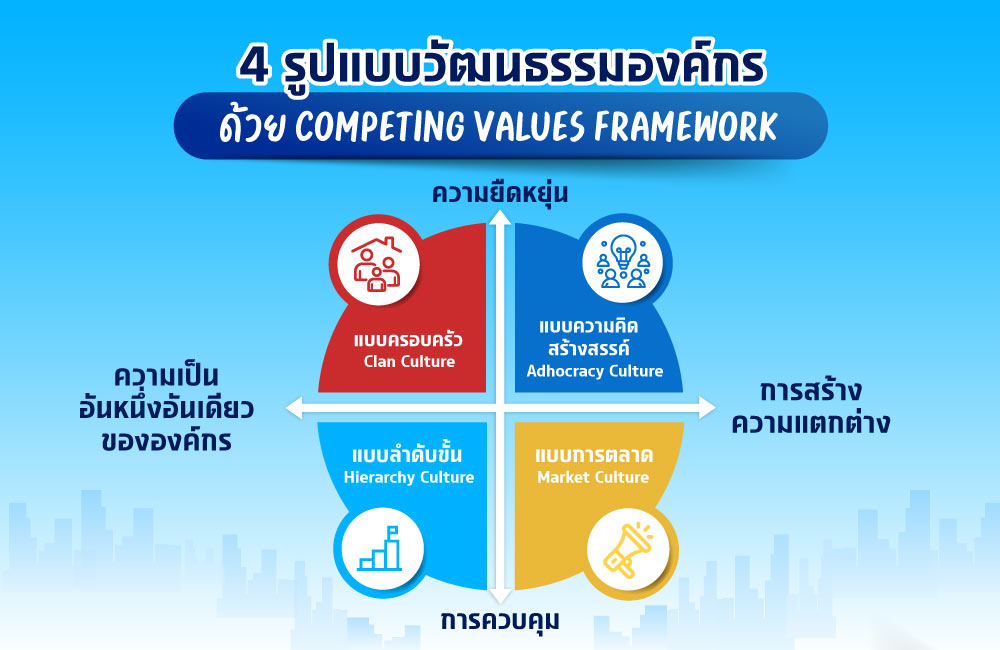
Clan Culture (Family Culture)
Family culture sees everyone as having value. Companies make employees feel like they're family members. It's a Flat Organization with little hierarchy, because it values communication and discussion most, which helps break down walls between positions and makes employees at all levels including executives closer together. This culture type emphasizes practice and has high flexibility.
Focus: Mentoring and teamwork
Advantages: Employees have high engagement and are happy with work. They adapt and handle change well because of high flexibility. Can make quick decisions without waiting for orders from above.
Cautions: This corporate culture is hard to maintain when the company grows. Additionally, with structure that doesn't emphasize commanding, daily operations may lack direction.
Found at: Start-ups and small companies, or organizations famous for culture like Zappos
Adhocracy Culture (Creative Culture)
Creative culture is the foundation of strong innovation and flexibility. So, we see companies with this culture are always ahead of others or industry leaders, with mindsets supporting employees having innovative creative ideas, daring to think and try, and of course these ideas must be able to create differentiation for the organization, create growth paths and success for the company. But to support employees going all out without worry like this, of course the company must be ready to risk accepting failure or mistakes that might occur.
Focus: Risk-taking, creativity, new innovations
Advantages: Employees have motivation to constantly develop themselves to create new things. Companies are usually famous and highly profitable.
Cautions: Companies must accept risks from trying new things without anything guaranteeing success. As for employees, they must also accept pressure from competition.
Found at: Usually found in companies in industries that need to produce new things constantly, like tech giants such as Google or Apple
Market Culture
Market culture values spinning numbers, emphasizing profit-making. Organization structure usually consists of employees at many levels, resulting in more complex work procedures and processes. This creates wider gaps between employees at different levels. And this culture type emphasizes crashing into goals and organizational success results in the big picture more than team satisfaction.
Focus: Competition, growth, successfully following goals
Advantages: Can profit and succeed, and having clear goals and measurements helps set direction to work in the same direction.
Cautions: Focusing on profit mainly may make employees lack work inspiration until burned out eventually. Especially when having to be in an environment where everything is constantly moving without stopping.
Found at: The goal of companies using market culture is to be the best organization in their own industry. So these companies are usually large companies already leading their field, like Amazon, and ready to compete with everyone who tends to become competitors.
Hierarchy Culture
Companies with hierarchy culture adhere to traditional organizational structure, are companies focusing internally with clearly separated employees and bosses. Besides strict structure, they also have detailed methods for doing things to create maximum stability and reduce risks.
Focus: Structure and stability
Advantages: Have clear direction and process to successfully follow goals
Cautions: No space for creativity, making these companies slow to adapt. Also companies that value company more than employee opinions.
Found at: Found in organizations not focusing on changing organization in the near future, but focusing on day-to-day management. For example, government agencies or fast food restaurants
Summary
After reading this article, some people might immediately think "Yes, our organization is like this." But some people might still be unsure which way to go. Taking the Organizational Culture Assessment Instrument (OCAI) test is another option that helps you understand your own company more deeply. Don't forget that the important heart in considering corporate culture format is knowing 1. Where you are now 2. Where you want to be in the future. If you can answer this question, you can find balance between shared goals of company and employees, to change the company's future to something better.
If you want to learn more about Ngern Tid Lor PLC's corporate culture creation and the way we've done it, join TIDLOR Culture Camp and exchange ideas about values with us!
Interested, contact 02-792-1888 ext. 5050 or fill out the form here to wait for a callback from Culture Gangster
Source:
https://builtin.com/company-culture/types-of-organizational-culturehttps://www.atlassian.com/blog/teamwork/types-of-corporate-culture
